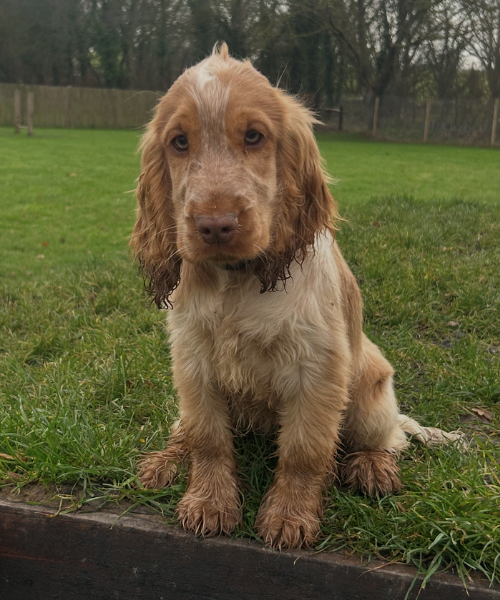
Humans and dogs are similar in many ways. Dogs are a social and emotional species just like humans. While they don’t have the same level of cognitive complexity, they certainly experience emotions such as fear and frustration and this is well studied in modern science. These emotions affect how we behave; if we are scared, we try to keep ourselves safe. If we are frustrated about something we try to find a resolution.…it’s the same for our dogs.
Dogs behave according to how they feel. If your dog is happy and relaxed, they will be in a good frame of mind for learning. If they are anxious, fearful or frustrated, they will not. Dogs show their emotions in all kinds of ways during training, it might be they stop responding to you, they might appear distracted or disengaged from you, they might bark or appear to become hyperactive. Behaviour like this is often perceived by owners as naughty, defiant or stubborn. This isn’t the case.
If you have a dog that is ‘reactive’ to things in the environment such as traffic, people or other dogs - there’s always a reason for this (often it’s fear or frustration). Dogs behave according to how they feel. If your dog is happy and relaxed, they will be in a good frame of mind for learning. If they are anxious, fearful or frustrated, they will not. We need to look at the emotion behind the behaviour first and foremost, because once we address the emotion? The unwanted behaviour is likely to disappear, or the dog will be in the right frame of mind for training. We cannot simply train a dog out of feeling fearful or frustrated, especially if there are underlying health conditions or pain contributing to their emotional state.
There’s another way that emotions affect the way your dog learns; classical conditioning (covered in one of my earlier blog posts). Classical conditioning is the process where dogs learn simply by association; this is how they pick up habits such as getting excited when they hear the rustling of a treat packet, or the sight of you picking up their lead. Something meaningful happens and they learn what predicts that thing.
There will always be a level of emotion attached to each thing you teach your dog.
When we teach a dog new cues we do this using a process called operant conditioning. This process is where your dog learns as a consequence of their own behaviour. A behaviour will become stronger (more likely to happen again) or weaker (less likely) depending on what happens after. So if your dog likes chicken and you give them chicken when they sit in front of you; they will be more likely to sit in front of you again in future. There are other ways of training which involve unpleasant consequences to decrease behaviour.
So how are operant conditioning (dog training) and classical conditioning (learning by association) connected? Classical conditioning is always there in the background! If you’re teaching your dog in a manner that causes them stress, the behaviour will have negative emotions attached to it. This is why I prefer to use positive reinforcement when teaching new skills to dogs; I want them to be able to do as asked, but also to feel good about it. But it’s also important to break down the learning process into smaller chunks; it’s not a pleasant feeling to feel confused and it can really knock a dog’s confidence or cause them to disengage from training. It’s important that we teach them gradually and in a way that makes them feel good about what they are doing.
Just look at any dog performing their favourite trick. Most dogs love to do a trick such as giving their paw! But why? Because when owners teach their dogs tricks, they are simply having a nice time together. The trick doesn’t really matter (it’s not the end of the world if your dog doesn’t get it!) It's the owner and the dog having fun together. This means that when you ask your dog to do that trick, it’ll make them feel good. It has good memories and good associations.
There are numerous studies which show that animals learn more quickly when training is enjoyable.
When we help dogs to feel positive emotions, we create dogs that are more confident and resilient. A dog that is confident and resilient will be less likely to show problem behaviour, because most of those problem behaviours are based on a lack of confidence, fears or not being able to bounce back from negative experiences.
Another benefit is a better relationship with your dog. If you think back to your childhood; which of your school teachers do you respect the most and have the fondest memories of? I can bet it was the ones who were kind to you and adapted the way they taught so that you were able to learn. Most people hold unpleasant memories of teachers from their childhood who were unkind or made them feel stupid. Which teachers taught you the most, the ones that made you feel good or bad? We can apply this to our dogs, they will have better memories of training with you if those memories are based on positive emotions and that means they will enjoy training with you again and again.
There are other ways we can build trust too. We build trust with dogs when we are able to recognise their emotions and respond accordingly. We can build this trust by respecting their personal space, be predictable, be kind, be patient, learn to read their body language and to never tease or torment them. Trust is earned over time and cannot simply be bought with treats. Trust is an entire way of living and interacting with your dog and will have an effect on all of the training you do together.
And if your dog trusts you, associates you with good things and feels positive emotions when they train with you; your training will be more effective around distractions too and even if they might be feeling a little worried, they will know they can trust you. It really is win-win!
Training is not just about teaching your dog to do new things or do as you say. It’s an entire way of communicating with your dog and whichever path you choose will shape how your dog feels in different situations and how they feel about you…
Blog written by Claire Mcknespiey of Educating Paws


